Friday, June 15, 2012

Samsung Galaxy Gio on Cyanogen Mod 7

So originally I had posted how great it was to get an Android device for next to nothing, which is a great thing. Who can argue at getting "almost" the same Android experience as someone who is technically spending $800 for $80... 10 x times less cost! The only real problems (that I have found so far) are this:
  • The screen is small.
  • There is no gorilla glass... be prepared for scratches and definitely put on a protective film. I have had to order and replace the digitizer because of an unfortunate key incident. Only upside is that it is now white, not black.
  • If you want to use it "like" a regular Android phone, you need to root it. 150MB of memory goes away pretty fast, so you need to use a2SD, s2e (simple2ext) or Link2SD (i recommend this if you are just going to root and that is it). Having an extra partition on your Micro SD card tricks your phone into thinking you have 2 - 4GB of internal memory, so you can load up all the apps you want without having the low internal memory show up.
  • No hardware decoding. I thought I was good to go for watching netflix or streaming some stuff over DLNA, but I was wrong. It only does software decoding, and it is pretty slow. It is fine for videos you have on your SD card, but streaming and decoding is definitely a problem... or maybe not if you don't mind the sound being 10 seconds later than the video.
  • No auto brightness. You might not think this is much, but it is SUPER annoying. Rather than having your phone adjust to your environment you are stuck trying to manually brighten the screen when you are out in the sun, and dim the screen when you are in a dark room.
  • Game compatibility. No jelly defense people, though it is a shame it is not like you couldn't see this one coming with the specs of the phone and the price point.

Aside from the above, I doubt you would really have a different experience than any other Android phone out there, since they all seem to be running Gingerbread. But that is for the stock ROM, it is so very much different when you are running a custom ROM such as Cyanogen Mod 7 (CM7), which is what prompted me to write this post in the first place.

I "used" to be the guy that would hack something right off the bat to try and get the most functionality that I could out of the technology that I buy. Over time though (with the family factor), this has changed and now I am the guy that only hacks if it is needed because I have no time at all to play with it, it just needs to work. So that being said, when I bought the phone, I fully intended to use it "as is" until I ran into the memory issue, which forced me to root the phone. More recently I found that my phone was slowing down and all the pre-loaded carrier garbage was taking up prescious memory that kept cutting off my podcasts to the point where I had to press the play button once every 10 seconds. Enough was enough, so I decided that it was about time that I do something about the problem.

Doing the research

So, from past experience on other devices I wanted to get all the information up front so I don't end up with a phone that won't boot for days since I have done something terribly wrong to the OS, so I sent out on a search on changing out the ROM on the Galaxy Gio 5660M (Bell Canada).

The first thing that I noticed most (as a person just getting into upgrading my ROM for the first time) was that this process seemed a little overwhelming,  while you can appreciate that Android is open and hackable, there is literally too much information to sort through when you first approach this sort of thing and that scared me a little bit, but not enough to stop.

At first it was slow going, as I got sidetracked trying to figure out whether or not I absolutely had to use a proram called "ODIN" or not; lucky for me I didn't and cld go forward from there with the following requirements to get this ROM installed on my phone:
  1. You need to be rooted first off.
  2. You need to get the clockwork mod (CWM) installed to replace the default recovery. 
  3. You need to use CWM to first, re-partition your SD Card (Gio Only, for that 'extra space') and backup your stock ROM (which in this case is CM7) in the event that you want to revert back to the factory OS.
  4. You need to download the phiexz version of the Cynogen Mod ROM and place it on the root of your SD card. I downloaded the file update-cm-7.2.0-20120518-Nightly-gio-AROMA.zip, you should be able to find it or a newer nightly build online by searching for the file. Start the upgrade process.
1 - Rooting

Rooting an Android device seems to be the same for the most part from what I have read around the web and consists of downloading some variation of an "Update.zip" file and using that to update the device in the recovery menu.

I won't go into too much detail as they did a great job on this tutorial at Android Authority on how to root the gio. You can find that here along with the files you need: http://www.androidauthority.com/galaxy-gio-s5660-root-68206/

2 - Clockwork Mod (CWM)

This is where I had initially thought things would get tricky as I had tried to do this a while ago via ODIN and failed. I took a stab at this again because as I understand it from everything I have read it is essential to installing custom ROMS.

I had initially found the latest version of CWM and simply downloaded it to my MicroSD card and ran the update. It did install, but there is something in the configuration where I was not able to mount '/cache', '/data' or '/system' which was a problem. Without being able to mount any of those file systems I was not able to do anything basically, let alone try to back up my existing stock ROM.

So when searching for why this was happening I came across an article that told me I needed a special CWM for the Gio called px-cwm-v2.zip. I found it here: http://www.mediafire.com/?p7r2bcn9447bpc8 but I am sure you can find it elsewhere if you search for it.

Once I had this and ran the update again from recovery mode, all was well and I was able to take my backup without issue.

If you are interested in knowing more about CWM, you can find another tutorial here (see... the power of open source and the communities around them? I barely have to write anything!): http://forum.xda-developers.com/showthread.php?t=1587607

3 - Repartitioning the SD Card

I am hoping that this little section will save you some time. Up to this point I was using Link2SD on my rooted stock ROM and it was working great. I ended up creating 2 FAT partitions on my MicoSD card using EASUS Partition Manager. But what I did find after loading custom ROMs multiple times is that it is best to leave that work to CWM.

My advice to you would be to do the following:
  • Backup all the contents of your MicroSD card elsewhere (because you will lose all your stuff out of the gate if you just partition with CWM).
  • Reboot your phone, go into recovery and then go to the advanced tools and select the option for partitioning your card.
  • It will ask you what size, I picked 2048, don't think I will have any large apps, but I think you can go up to 4GB in size.
  • Once you have finished partitioning, just pop the MicroSD into a card reader and copy all your backup data back.
The reason I am suggesting this up front is that the version of CM7 I used comes with the option of using A2SD or S2E right in the ROM, so you don't have to do anything funky to get it working other than having your MicroSD card partitioned properly.

4 - Downloading and installing CM7

As I mentioned earlier, I had installed various versions of the custom ROMs. I intially started out thinking that I wanted to get the latest and greatest version of Android and went for the Gio build of ICS (cm_gio_galaxyics-10062012.zip). Initially it was a total failure, the install went fine, but when rebooting my phone was stuck either with a blank screen or in a boot loop. So I decided to try the older version of CM, which is how I got to CM7. Oddly enough, after successfully installing CM7 and again trying to install CM9 Beta8 (ICS) it actually worked... but I couldn't live with a camera that wouldn't show me what I am taking a picture of... will wait for that to mature a bit futher.

So back to CM7, all you really need to do as mentioned above many times is to copy the ROM to your MicroSD card and then go into CWM and select an update from the MicroSD card and apply it (just make sure you pick S2E in the setup, leave everything else as default). Simple! Once the install is finished, it will simply reboot right into your new OS, it will just take a little bit longer on the first boot to get into the phone.

Post Upgrade

First of all... I can't sing enough praises to the people that are working on Cyanogen Mod as well as Phiexz and others. If you go through the above process with their version of CM7 there is an amazing install (not sure if it is part of this build alone or for CM7 in general), it's as if you are installing a commercial OS!

The difference between the stock ROM and CM7 is night and day. Here are the benefits I noticed off the top (have been using it only 2 days before this post):
  • It is noticably faster.
  • You are not forced to use the apps that Samsung defines at the bottom, it includes ADWLauncher and themes you can select during ROM install. I picked the ICS theme.
  • My battery lasts a bit longer.
  • No more bloatware (no Samsung or Bell apps loading into memory).
  • Oh... so much more configurable, I would almost say that there are too many options.
  • Build in S2E... provided you have the partitions set up right before the ROM install you can in and configure everything to go to the other partition. And unlike Link2SD, where it links stuff to the MicroSD card after install, S2E just installs it straight to MicroSD.
  • WAYYYYYY Better Camera Software. I am not kidding... it is night and day difference and it is much more convenient to use. Tons of new options that are quickly configurable.
  • Cool screen shut down (like an old style CRT shutting off with the line down the middle)... not big, but cool.
I was on the fence about doing this earlier, but I am 100% in favour of anyone using the Galaxy Gio to do this and get a much better Android experience out of your phone.

I will post some of the screenshots up when I get a chance to.

Monday, May 28, 2012

Facebook is going to buy my browser

So finally, aside from another RIM story, there is something that has caught my interest, and that is Facebook potentially buy my browser, Opera.

Why is it my browser? Well, because it has been so good to me over time... that's why. Way back when beige box towers were the 'it' thing and laptops were not as prolific as they are now (let's say that's around 1998 or so), I had a problem. I had a 386 laptop (monochrome) and I wanted to get to the internet on my external 36.6K modem. Because the laptop had only 1 serial port I had a choice... mouse or modem. So, I chose modem and tried to get online, and did, but surfing was hell. Using netscape or IE3 was a pain, I couldn't get to some things because I was not able to click on them (think I forgot to mention it also lacked a nub or touch pad). So long story short, I look for a solution to my internet navigation issues and find that Opera, a browser I never heard of, was able to help me with all my navigation woes. I have used it ever since, and loved it. I cannot believe that it has not gained in popularity because it has so much more to offer than the other browsers... maybe because it offers too much?

Anyway, back to the point of this post, I had an instant pang of disappointment when I heard the rumours. I thought to myself "There Facebook goes again, ruining something perfectly good, just like Instagram". Now that I have had some time to digest it... it will have some good things, but will also have some bad, as everything does. So here is what I am thinking:

Good:

  • Opera will get a lot more marketshare a lot faster: Facebook has a huge audience... if they promote "their browser" and if they bake in features that only it could have with some super secret special API, many people would try it and or just use it because it is easier and also since the spend most of their online time there.
  • Opera will advance by leaps and bounds (maybe?): Opera's problem from the start is that it isn't a big company. It doesn't have the resources to dump into their browser like Google and Microsoft do. As I recall, it was the last significant paid browser hold out and it didn't seem that they were too happy to move from that model until the advertising revenue started to pour in. But despite the fact that they don't have as many resources, they have absolutely killed it with the functionality of this browser. I personally think that most of the 'cool' features that the other browsers have were lifted from Opera. With facebook behind it, it could accelerate the development and turn it into something very unique.
Bad:
  • Facebook Integration: I use Facebook, I don't have a problem with it really... most of the time. But if they have their own browser, would you have to 'log in' to use it? That will probably be unlikely unless they really want to dig into what you do on Facebook and also outside of it, could really help with targetting ads. At the very least, they would have any problem getting cooking information.
  • Trust: I don't think Facebook comes to mind when people think of trusting a tech company, even Google is starting to have the Facebook problem in light of the problems that it has had over time. But clearly non of us has forgiven Facebook for all of the tests they opt us in to, mistakes that they have made over time and I am fairly certain that everyone is pretty certain that they are being tracked in some fashion by them. So if I have an Opera that will be baking in Facebook features, how far can I trust it? Or maybe the better question is how can we trust anyone? To me it seems that the browser seems to be one of the key methods of obtaining information about us and what we do, so I am certain that Facebook would use this for all this is worth, much like google is currently doing with Chrome.
But Opera isn't really the big story here is it? The big story is that Facebook is buying a browser and what that implies.

I guess I would consider myself silly to think that Facebook is just a website or an application on a smart phone, because it is apparent that's not what Facebook wants to be. Especially when the IPO for Facebook now brings regular investors into the mix they are going to have more control on the direction of the company. I am not sure what Zuck wants to do, but to me it is clear right now that Facebook is getting ready to take on Google.

It is kind of hard to say exactly how they intend to do that, but if they are buying a browser, then they see value in what Google is doing with Chrome. They certainly do think that Google has something with Android as well as they are on their 3rd try to make a Facebook phone, I wonder if it would run on Android? Maybe the Google mantra of just giving stuff away as long as people are using a Google product in some way shape or form. Also, look at what a behemoth Google is and that is just based on their ad revenue! All Facebook needs to do is to replicate what Google has done up to this point and then exceed what they are doing. I think have have seen somewhere online that they are mentioning something about a Facebook search engine and it wouldn't surprise me if there ended up being one.

So I won't be surprised that if the acquisition of Opera (now that they have the IPO money) is the first of many steps to make Facebook more like Google. I wouldn't be surprised if they go on an acquisition rampage.

Tuesday, April 17, 2012

Problems with Buongiorno Gamifive Mobivillage and Rogers 3rd Party Billing

Update 09-17-12: 

Got this update from Joanna with a link to some good news! It appears that everything we all have guessed about (that the carriers are making money off of these 3rd party companies) seems to be true. Hopefully the media focus and cost of the lawsuit will put all  nonsense to an end. Thanks for the link Joanna!

"Joanna has left a new comment on your post "Problems with Buongiorno Gamifive Mobivillage and ...": 

Hi everyone: Good news! Hoping this will prevent other cell phone user to go thru what we've gone thru! 
http://www.competitionbureau.gc.ca/eic/site/cb-bc.nsf/eng/03499.html
Also, just a quick update since my last posting on Aug 13. I've got email confirmation from Buongiorno for a full refund BUT I've yet to believe it until I ACTUALLY see it in my account. I choose to believe that we are in a different billing cycle and so it could take couple of months to see the full credit."


Update: I found an article on line that perfectly describes what they are doing, it is called "cramming". They take advantage of a loophole in LEC (Local Exchange Carrier) billing, and need only your phone number to start charging you money. I fail to see what service could be so valuable that this is enabled by default, allowing virtually anyone to charge you if they have your mobile number. Give it a read.


Recently I have spotted an anomaly on my cell phone bill that has gone unchecked for over 3 months.


3rd Party Billing: As it appears on my phone bill. Notice the small print.


Unbeknownst to me, I had purchased a 3rd party service that has a recurring monthly charge of $9.99. The only evidence that I have at all regarding this service are 3 SMS messages (no bill or paper) stating that I am enrolled in this service. I had absolutely no idea how this happened.


Buongiorno Gamifive Mobivillage SMS Message: The ONLY notification you get that you are subscribed to something. 
So I went on a little adventure to find out how this happened, what I could do about the charges and how to prevent this from happening in the future.

How it happened:

The first thing I did was to check out the website to see what this 'service' is, and the first site I found about this company was a complaint site called 'Gripevine' which completely outranked the business itself on Google, so I knew it wasn't looking good for me.

I decided that I would poke around the Buongiorno Gamifive Mobivillage site to find out what it was. I wasn't really surprised at what I found, which were basically really low quality games:


Counting Sheep: Even the creators of these games find them so boring they can guarantee you will fall asleep playing them. 

Arcade Pong: Ah yes... the age old game of bouncing a ball on a paddle, only virtualized. Amazing.

Drop Flowers: Dropping flowers has never been so much fun! </sarcasm>  

Fat Girl: Aside from being completely offensive, apparently it is fun to guide something into a ring. 

Pumpkin Land: Doesn't appear to have pumpkins, nor is it a land. You lamely guide your finger up the platforms. Sounds super fun! 

Sheila Dressup: Believe it or not, there are like 5 of these, all the same, different girls possibly different accessories. Ultra lame. 

As you can see from the above pictures that the quality of the games is terrible and remind me of the games you would see when you had to use a WAP browser to get to the internet on phones. Most of the games are fundamentally the same, just with different back grounds and pictures. It does not look like much time was spent at all putting the site up or making the games, as if it is just a place holder. Why on earth would I, my wife, or anyone want to pay $9.99/month for basically the same game with different pictures especially when we are in the smart phone era with tons of high quality $0.99 or free games?

It seems to me that someone needed to make a placeholder/front for their service so that if there were any litigation over it's billing practices that they could say that they had offered them a service.
It is my opinion that this is a 'shady' service that is clearly preying on human behaviour:


  • People don't seriously check their messages: So if you were not paying attention (which is my case), and don't see that slick little SMS message pop in to say that you are subscribed you are raking in $9.99/month/person until they realize they are being scammed. 
  • People never check their bills: Most people don't, or the people I know. And it took us 3 months to find it on ours. So again... they are getting the $9.99/month/person * the amount of months it takes to realize that there is an incorrect charge on their bill. 
If you have no ethics or morals this is a great business model, especially at $9.99/month. Even if they did provide some form of a refund to people that call in to complain, they most likely will not give up 100% of the money that they obtained. So they are essentially printing their own money, and I think they know it.

So now that I know who I am dealing with, I needed to back track to find out how I could have possibly subscribed to it, checking such things as: 
  • Browser History. 
  • SMS History. 
  • Apps that might contain an Ad that my kids could have clicked on. 
But despite spending hours going through all of that, I could not find anything anywhere that would indicate how I provided permission for this unknown company to start charging me $9.99 per month to my cell phone bill.

What I could do about the charges:

If you want to save some time reading here is a summary, not much, but I will go through the thought process that probably everyone goes through when being ripped off.

It starts out by being completely irate, then it proceeds to be a call to Buongiorno Gamifive Mobivillage as per the SMS message to find out why we are being charged and to demand a refund followed by a call to Rogers to ask how this happened.

Call to Buongiorno Gamifive Mobivillage:

To my surprise, the Buongiorno Gamifive Mobivillage customer service didn't seem to be all that terrible, but then how can you be if you are customer service. Though they didn't seem to listen to any of the 'gripes' we had about this service just appearing on our bill (which is probably the only reason they get calls, so routine), they did 'say' that they would refund some of the money, though I have yet to see that.

The only thing that was consistently said on the phone by the customer service representative was that 'we subscribed', though they could not tell us how that happened. They also mentioned that we were notified by SMS and could have cancelled anytime, as if that is a valid excuse for being charged for a service that I did not know or want.

So after some back and forth and on the promise of a refund, we had hung up with them hoping that at some point in the future we would see a credit to the bill, though I am completely skeptical of this happening.

Call to Rogers:

The customer service experience on the call into ROGERS was not all that good. The person that I had on the phone I could barely hear, as if they were in some sort of empty room on a terrible phone, far far away from the microphone.

So after getting through all the security questions, we get into the reason for my call and I explained to the CSR that I found a charge on my bill that I did not agree to and that I want a refund for the charges. After being put on hold for a while, the CSR came back and rather quickly told me that this is a 3rd party charge and I would have to contact the 3rd party to get a refund for the charges.
I then ask the CSR, how is it that they are able to charge my account directly? I went on to explain that I had never received any information on this service and that I had never explicitly authorized another charge on my account. I was again put on hold and then the CSR just came back with the same answer, that I must have signed up for something somehow and that they cannot do anything about the charges.

I then asked a series of other questions, where the CSR had started to put me on hold for gradually increasing amounts of time until I finally asked if I could speak with a supervisor. I was put on hold again only to find that I was subsequently passed into another hold queue, a french language one. Eventually it was picked up again, but it was as if they couldn't hear me and the call was ended.
My wife didn't fair much better when calling in to discuss the same issue, she was just told that they had blocked 3rd party billing.

Neither of us were happy with the customer service we were receiving, especially since all CSRs are implying that:
  • We willfully subscribed to the service. 
  • There is nothing they can do about 3rd party services. 
  • That the disabling of 3rd party services might somehow affect our ability to use our phone. 
How to prevent this from happening in the future:

To make a long story short, the only thing you could do at this point is opt-out of 3rd party billing. This means that you have to actually know what 3rd party billing is, then call into Rogers to have it blocked.

After my miserable experience with the phone based customer support, I did try hitting twitter and found that I got a much faster, and better experience by tweeting @RogersHelps, I would recommend going to them. The gents that helped me were knowledgeable, very helpful, but eventually gave me the same answer as the phone CSRs did. They did provide this useful link which is great for understanding what 3rd party billing is and Rogers stance on it:

http://redboard.rogers.com/2011/rogers-offers-premium-sms-choices-for-customers/

The article describes what happened to me as a 'feature' that is now available to Rogers that they call 'Premium SMS choices'. Here is the descriptive paragraph out of the article:

Premium SMS messages often charge an additional fee above standard text messaging costs. The costs usually range from $1 to $10. You can subscribe to a premium SMS service online by inputting your mobile phone number or by texting a specific short code (usually four or five digits). This could include submitting your mobile number on online contests, to win a tablet for example. Always read the terms and conditions before submitting your mobile number online. Regardless of whether a subscription is initiated online or through a mobile device, there is always a two-step activation process. This includes inputting your number online or through your mobile device and sending a confirmation ‘YES’ text to complete the subscription. Once confirmed, you are then charged for the messages until you ask them to stop.

Sounds good, but this never happened to me, there was no text out to subscribe to anything. Nor was there a confirmation SMS saying 'Yes' please bill me $9.99/month. The above paragraph is exactly what SHOULD happen... I ask for the service and I confirm that I want to be billed for it. Clearly there is a loophole to this that allows people to bill my account without this 2-step process and that is what needs to be addressed. I am not clear on how this company slipped through the cracks, or how many companies like this there are.

What I think Rogers needs to do:

The safeguards described in the article are good, I never got the chance to see if any of them work however. But what I think they need to do to improve customer experience is: 


  1. Refund all accidental 3rd party charges to Rogers customers: This would obviously be within reason, but for people that have 1 or 2 charges on their account, not knowing what the service is, Rogers should go to bat for them. They have the clout (being a huge carrier) to claw back wrongfully taken funds from their customers. I wager that if they looked across many of the accounts they would see these sort of charges occurring and could proactively do something about it. It is much harder for each individual to get their money back than it would be for Rogers to get the money back for them. 3rd Party providers should have proof that we subscribed knowingly, if that ever comes into question.
  2. For any charges above regular phone usage: Anything that Rogers does not provide should be highlighted and very visible to customers. If there is a 3rd party charge, then it should be easy to find, maybe accompanied with a Rogers SMS message or some other form of notification to make the people that don't check their bills or don't see the fine print aware of these extra charges. 
  3. Block 3rd Party charges by default: Take it from 2 steps to 3 steps. Rather than subscribe to something directly, start by SMSing the customer and asking if they would like to 'enable' 3rd party billing. This way they could determine what it is before charges are laid. If they already know what it is and are intent on it, they will respond with a yes. For the ones that no one knows about, there can be no charges until it is enabled, so it can't be done by accident without explicit permission from the subscriber first. 
  4. Proactively scan and resolve 'scams': Periodically look at all the 3rd party charges being applied to Rogers accounts. If there is a higher than normal subscription rate (perhaps like Buongiorno Gamifive Mobivillage) investigate and determine if subscribers were legitimately subscribed or not. If you blocked 3rd party charges by default it would be less work as the subscribers that enabled 3rd party billing would be susceptible to bad billing practices. 

Wednesday, April 4, 2012

Is RIM beyond hope?

It's been a while since I had written a post on RIM and thought that it is about time, given that I have some sort of fixation on them having to use them in my daily life. Anyone who has been watching the news recently knows that the company's stock has slid 5% down to $13.65 yesterday, now 75% lower than just 12 months ago, so things aren't going well and like me, everyone is sitting around waiting for RIM's last hurrah when the Blackberry OS10 devices come out.

RIM is in a terrible position right now and I don't at all envy Thorsten Hein's position having all the pressure to do something to try and salvage what is left of RIMs business. The only good news that we are seeing is that he and perhaps the board are starting to see the big picture and do something about it, only that it may be too late.

I think they have done good by:
  • Removing Jim Ballsillie: This might be more symbolic than anything. But since he had been put into the role of CEO and both Mike Lazaridis and Jim Ballsillie landed softly into board rolls Thorsten has never been able to shake the stigma that he is just the puppet of the two former co-CEOs. Initially that's all that it looked like, he came in trumpetting their approach acting like there is nothing wrong, but by getting rid of Ballsillie (not sure about Mr. Lazaridis), they are giving us a sign that he can no longer contribute to the direction of the company and that he really does want things to change.
  • Removing top exectutives: David Yach and chief operating officer Jim Rowan were let go as well as other high level staff. THE PROBLEM IS: While you are getting rid of the 'old' mentality you are going to have to replace them with new bodies. It may prove to be difficult to fill all these high level positions in a short time considering their big turnaround HAS to happen this year.
  • Admitting the difficulties that RIM is facing: It is about time that someone flat out said what was going on with the company. Jim & Mike were always trying to put a spin on the reasons that RIM was faltering and trying to evangelize their plans for a turn around even though it would never materialize. This will give investors and your average person more confidence in a CEO that admits there is a problem rather than living in a time bubble back when everything was still good. 
  • Developing mobile fusion: I was skeptical of this from the start because I thought this would almost definitely cannibalize the sale of their blackberry devices. But since most people are now opting for Android and iOS devices nowadays, I am fairly confident that at some point in the future there will be no blackberry hardware. Mobile Fusion is putting the focus on their back end infrastructure and what is rapidly becoming their most important asset. 
  • Putting a sale of the company or its assets on the table: Old co-CEOs would have only mentioned that they were open to licensing the blackberry OS, as if anyone would want anything to do with what is behind the demise of the company. Putting all the options on the table is good news because it leaves the possibility of a sale out there that could help with investment and also confidence that no option is off the table. THE PROBLEM IS: RIM might be too far gone to be sold, given that it has lost nearly all of it's value. The only thing left that I believe could be purchased is their patents and their back end infrastructure.
What I don't think they have done well:
  • Communicate their direction & message well: Thorsten doesn't seem to be able to communicate direction or if they really pulling out of the consumer market. I have always thought that if they were having issues that they should focus on their core business and try and fix that the consumer part of their business seems to have made them scatterbrained so that they lose focus and what they should prioritize (Playbook, Storm, Torch). THE PROBLEM IS: The consumerization of IT is already in full swing, no one wants to carry 2 devices anymore and want their 1 perfectly capable phone to do everything. They do sort of have their bases covered with Mobile Fusion, but their hardware business is pretty much finished in my opinion.
  • What about the blackberry ecosystem? We don't know what is going happen to BBM or the integration they were speaking of when making deals with the recording industry for Blackberry music. What will happen to all the money invested in music deals for the blackberry music?  
  • Bad publicity: On top of the drunken executives that forced an emergency landing, there was a stabbing at a promotional concert for BBM which seems to have overshadowed the event itself, just like the drunken executives did.
  • Provide message of hope to developers: I am not sure that I have seen any indication in news or otherwise that developing for Blackberry is going to be worth your while. I am seeing that developers will get a free BB10 device, but I don't see them providing any guarantees that they will be handsomely rewarded for developing on a platform that has every indication of failing at some point in time. They should be offering nearly 100% profit for the apps and other incentives to catch developer interest, everyone knows that if you want to make money you develop for iOS and Android, but they need a really good reason to develop for blackberry now.
  • Trying to market an old OS: When they knew they would not be able to ship the BB10 devices on time they decided to drop some money on advertising BB7.  Anyone who has seen any of the ads can only see improvements in providing: Mobile Hotspot (which will be promptly shutoff by most IT policies in addition to WiFi), NFC (no one uses this for payment yet, for now is just a buzz word), WiFi Calling (this is just software, most likely it is provided by carriers, but other apps like Nimbuzz had it since at least 2009), FM Radio (nice to have, but virtually no one uses it), AutoSuggest (Not that I have seen it, but it is most likely tied into google somehow). There really is nothing compelling me to buy a BB7 device, especially since there is no guarantee that my BB7 device can run BB10 when it eventually comes out. You do have to sell the devices, that is a given, but I don't think anyone is naive enough to think that BB7 is a major revolution in the OS... since in my opinion we haven't seen that yet at all (BB2 - BB7, the only things I have seen as improvements are music, camera, expandable memory and some apps. The OS is fundamentally the same... the only real big change I remember is going from a C based OS to a Java based OS). 
I honestly think that for the most part, RIM is beyond salvaging in it's current form as it is too late to catch up with other hardware makers. No one will honestly want to purchase a BB10 version 1.0 phone with no applications when you can get a fully featured Android or iOS device, you would deliberately be committing  yourself to issues similar to those that occurred with the Playbook and OS updates/fixes. So that being said, this is how I see the future of RIM:
  •  RIM gets purchased outright: I can see either Amazon (because Jeff Bezos seems to love RIM) or Microsoft purchasing RIM. Amazon has the kindle, kindle fire to tie into their ecosystem, but they do not have a phone. They could use RIM to break into the enterprise and also to manufacture Android phones to fit the hardware that they are missing when compared to Apple/Google. Microsoft could purchase them just to deepen their foothold in the enterprise and lock down Windows Phone 7 as the only enterprise capable phone (probably getting rid of Mobile Fusion save for Windows Phones). Windows Phone 7 definitely needs some sort of edge in hopes of catching up to Android and iOS, so anything could help.
  • RIM leaves the hardward business and focuses entirely on enterprise software: They are already well positioned to do this with Blackberry Mobile Fusion, so they could pool there resources around owning Enterprise Device Management and E-Mail. To this day there is still no device that does e-mail better, so if they can enable this on Android & iOS phones (like they did with the PalmTreo650) then they would own that space. Good technologies is attempting to take ownership of this space, so they would be their biggest competitor. RIM could then live off the licensing fees of Mobile Fusion and look for other areas where they could add value.
  • RIM switches to Android: I am not entirely sure on this, but it is possible that if BB10 is a complete flop, that it would be far less expensive for them to become an Android handset maker in addition to being an enterprise device management leader. So if you can't get the developers to come to you, you can go to Android where the developers are and continue to make money on handsets as well as licensing. Mobile fusion would then theoretically allow them to do this almost seamlessly as they are trying to address the BYOD movement with the software already. 
I don't really see too many options beyond these, and time is of the essence for the sale of the company as it has lost so much of it's value it may not be worth selling. I do think they can succeed as an enterprise software provider and I fully expect them to do something like this if BB10 turns out to be a complete flop.

I wish them the best, I really do. I don't hate them, I just hate the OS and it's lack of functionality. I will be watching their developer conference with interest (to get an idea of what BB10 is like and its functionality). Come November, if we are not blown away by the new devices and software I can see one of the above scenarios playing itself out.

Friday, March 9, 2012

Windows 8 Consumer Preview

Microsoft announced on February 29th, 2012 that they have officially let the Windows 8 consumer preview loose on the world making it widely available for download. Seeing that news, I had about a 2 - 3 minute fight with myself as to why I should or shouldn't ruin my perfectly good Windows 7 installation before my curiosity won out and I went to the website and downloaded the web install (thinking it was just a download tool that would give me an ISO file to burn). So I would like to share with you my experience with installing the new OS (twice I might add), what I think of it and definitely all of the things that needs to be improved.

I thought it would be best if I broke this down into 4 sections:
  1. Web Installation
  2. Fresh Installation
  3. Brief overview
  4. What needs to be fixed
I won't get into any detail as to how you configure it or any of the nice new features as that would take quite a bit longer and I have to admit that I don't have it all figured out yet. I will however share something that helped me clean up some tiles and soothe some of the 'Start Menu Withdrawl' that all of us that aren't using it on a tablet will have.

Web Installation:

To be honest, I thought that the web installer was going to be one of those download tools that you HAVE to use to get the ISO down from wherever they wanted to hide it. I was quite surprised that it was actually the install tool an was going to upgrade my Windows 7 Professional installation to the new Windows 8 preview.

I am actually quite shocked at how well this worked, and if it wasn't for the fact I generally think it is not a good idea to upgrade from any previous OS (except Linux with keeping the /home partition) they did everything exactly right. You click on the installer, it downloads, installs and reboots and depending on your download speed, you are up and running with a new Windows 8 installation, as simple as installing any other program on the system.

The only caveat that you must know is that there is NO UNINSTALL. You can't simply try it out and uninstall it, it alters your system so much that this is not possible. So consider a virtual machine if you do not want to lose your existing Windows installation.

When I did try out the OS I did have a lot of left over garbage from my Windows 7 installation (namely the fact that I used a Mac theming program to make my system look like it was running OSX Lion). Some programs didn't work and there were a few other oddities, which is why I recommend that if you are going to try this, do a FRESH INSTALL. At least that way you know that everything is working as they had intended it to.

Fresh Install:

So with all the problems that I was having with the web install version of Windows 8, I wanted to start from scratch, so I went poking around for the Windows 8 ISO download. You can find it if you look, but I was maxing out at a 67KB/s download rate, which would have taken forever to get down to burn onto a disc.

Web Install Tip: If you have done the web install (which is super fast I might add), then you already have 2.8 GB sitting on your C: drive doing nothing. So rather than download the same thing twice, you can take what was placed on your hard drive for the web install and make that into a burnable ISO file to do your install. Here's how you do it (bear with me, this is from my memory as I finished the fresh install):
  • Locate C:\WindowsEDR (or something like that) to ensure that you have the necessary files. The directory should be around 2.8 GB in size.
  • Download this tool: http://www.sevenforums.com/attachments/installation-setup/72576d1273718566-boot-cd-dvd-bootisomakerv2.zip 
  • Unzip the tool and then run the batch file within it.
  • It will ask you for the boot.wim file, so go to C:\Windows EDR\Sources and select boot.wim.
  • Once you pick the file the program will begin to make the ISO file from the downloaded web installer files.
  • Once the ISO is created (it will be created in a 'VirtualStore', so you may have to search for it).
So using the above steps I took the windows install files that I already had, created an ISO and then burned that to disk, much better than the 13 hours I was looking at for the ISO download.

The install of Windows 8 is identical in almost every way to Window 7, so it shouldn't be to hard to figure things out. I wiped out my entire drive and let Windows 8 have it's way with the file system.

Once the install was done, the system booted up and I began once again to setup Windows 8 from scratch. I have to admit that it is much more fast than the upgraded Windows 7 version and also a lot of things that were previously causing me issues were now gone.

Brief Overview:

As a user of Windows since version 3.1, I have seen every evolution of the OS and the revolution that happened since they switched over to using Windows NT technology, vs. the older DOS/Windows combination I thought I would be able to figure Windows 8 out relatively quickly, but I was wrong. The changes that they have made to the OS up front are quite strange and anyone used to the traditional Windows "Desktop" metaphor will have some things to get used to.

Metro UI:

This is supposed to be the greatest advance in Windows since the switch to NT technology, but I think it falls quite short of a great advance. The first thing you will notice upon completing the various setup screens is that at the end of it all you will see this tile interface:


Metro UI

It will probably look a bit better than this given that I have changed a lot of it, but essentially you will be looking at this screen. Now before I go too much further, a colleague of mine at work looked at the UI today and said... "Hey, that looks like Lotus Notes!" I thought to myself... how does it look like Lotus Notes? Then it dawned on me... the little program squares do look JUST like Lotus Notes databases on the workspace:

Lotus Notes 6.5.1
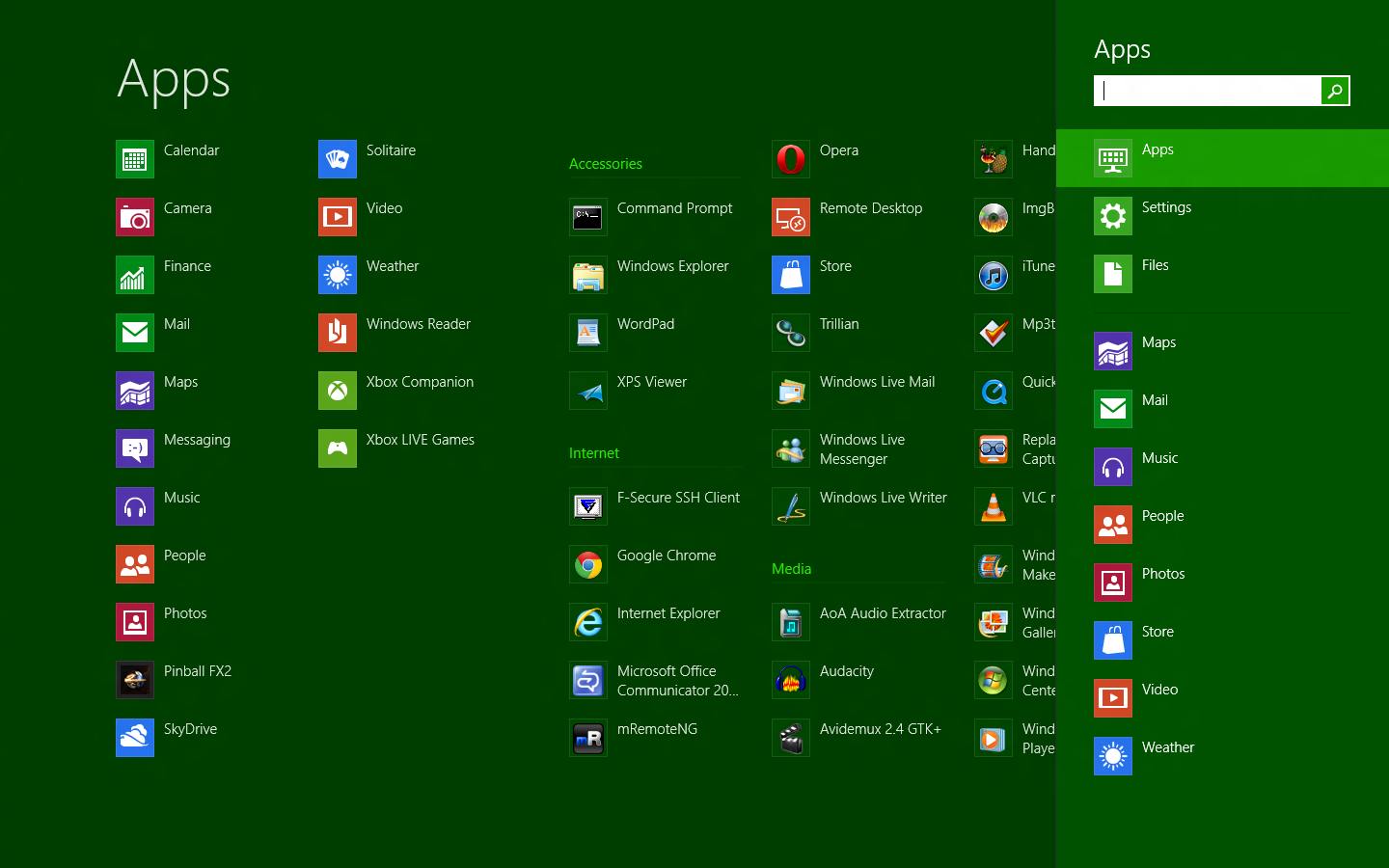
Metro UI Application List
I thought it was hilarious and also somewhat uncanny. 

Application Selection:

Metro reminds me somewhat of Gnome 3.0 in the sense that you have a screen that you use to type a search term for the application you want, or you just click it from the screen right in front of you. Non-touch screen users of Windows 8 (myself included) have no reason at all to stay in the Metro UI as it doesn't really serve any purpose for people using keyboards and mice, it actually makes Windows look a little unkempt. 

Gnome 3 Application switcher/search
Metro Application search
Metro App Switcher:

When in Metro or Deskop, when you move your mouse up to the top left corner of the screen you get presented with an application switcher. Before you get too excited, it is not at all like the way the workspaces work in Gnome 3 nor is it a fancy new way of switching between applications in Windows 8, it's sole purpose is to help you switch between Metro apps.

The switcher works almost exactly like the Android recent applications function works, and it should because it is pretty much identical, just useless for Desktop users.


Charms:

Not sure why they call them charms, but when you move your mouse pointer to the top or bottom right hand corner you get a bar that slides in. The bar itself is not customizable and only has 5 items on it: 
  • Search: Which takes you back to the application search window.
  • Share: Which doesn't seem to be what you would expect for something that says 'Share'. It seems to share specific things and doesn't work the way sharing a folder might work. Try as I might it wouldn't let me share anything at all.
  • Start: Brings you back to Metro
  • Devices: Is again another example of not getting something you would expect such as all  the devices that are removable. I only ever get shown 'Second Screen' when I click it.
  • Settings: This is about the only useful button on the whole thing. From here you can go to the control panel, install themes, view computer information, alter your sound, brightness, networks and notifications as well as power down Windows (which is actually tricky since there is no start button).


Cloud Integration:

I haven't tried this out too much but the OS seems to tie in with SkyDrive as well as all the major social networks. I also didn't have to create a local ID as I am using my hotmail credentials to log into the machine (even when I am not network connected). If it does a better job of integrating with the cloud, I can see why the cloud is becoming an important part of an OS. If it is anything like what Google has done with Chrome, then (namely upon sign in all your apps, settings and bookmarks are restored) then this will be a great feature.

Skydrive is available (so far as I can tell) only via the Metro start screen. When you click on it, it basically brings up more squares showing some pictures and some folders that you may have up in the cloud:

Skydrive Layout
While you can go through items in your Skydrive and save items locally by right-clicking the item, there is no way that I could find to send a file up to Skydrive. 

Ribbon Everywhere:

Explorer Ribbon
For the desktop, the Office ribbon has made it's way to Windows explorer and most MS products now have the ribbon interface.

What needs to be fixed

It is very clear from this demo that they are pulling away from the traditional 'desktop' metaphor and moving into Apple's 'app' model, which makes sense especially with the focus being seen on tablets and mobile OSes. They are also attempting to unify the experience across phone, tablet and desktop (possibly Xbox??) to make it easier to develop for and also reduces the learning curve for each of the listed devices, which also makes sense.

The problem is that it appears for the moment that they are going to do this at the expense of their biggest user base, the 'Desktop' user. When installing the consumer preview on my own system, it did take some time to find out where things were and to get accustomed to certain things.  But one thing that I don't think that any Desktop user will get used to is the fact that the Desktop is now an app and that you will always have to look at that big blocky Metro UI if you want to launch a program. I imagine that the outrage over this  and the fact that this couldn't possibly work for a business user will inevitably lead to allowing the Metro UI to be disabled in favour of the start menu, but time will tell.

In the mean time, if you do 'sorta' want your start menu back just create some links to your user start menu and to the all user start menu so that when you open explorer, you can navigate to the programs you want or clean up the start menu junk as I like to do. You can find the directories here:

Your Start Menu:C:\Users\<yourusername>\AppData\Roaming\Microsoft\Windows\Start Menu\Programs
All Users Start Menu: C:\ProgramData\Microsoft\Windows\Start Menu

Here are the things that I think they should fix:

MetroUI as an option: 


As I said earlier, they are going to be alienating all of their Desktop user base with this release and possibly working on the next Vista debacle unless they make this optional. Even if they want to 'force' people to adjust to the new reality of friendly touch interfaces and OSes, there is no way they can make this big of a jump so quickly. I am technical and have no problems using Windows, but even I had problems getting used to this OS and finding anything in it, I shudder to think of what might happen to people like my parents if they happen to buy that next computer with Windows 8 running on it.

There is also the fact that the enterprise will never buy into this. Unless there is another SKU for Windows in the enterprise you can expect the vast majority of companies to stick with Windows 7 about as long as they had stuck with Windows XP. And if there does happen to be a SKU, I wouldn't think it is hard to imagine desktop users flocking to buy it vs. the consumer release of Windows 8.

Make it an option and save yourself and everyone else a headache, the UI doesn't make sense on a non-touch PC.

Shutting down the PC:


Believe it or not it is hard to figure out how to shut down your PC. I couldn't find it initially, so to shut my system down I resorted to running 'shutdown /i' so that a window would pop up to allow me to shut the system down. To my surprise, despite my explicitly asking the system to shut down it only hibernated (albeit quickly) and when I started the system up from what I thought was a cold boot I was surprised to find some programs I had previously opened reloaded.

This appears to be another Microsoft attempt at pushing us towards purchasing that Windows 8 tablet because this hibernate/suspend behaviour would only be good for a tablet device. In my case, and what I will mention next, I was having an issue with my wireless card connecting to anything. The first thing that anyone typically does is restart the computer to start fresh and eliminate any possible issues that might have caused the problem.

Full Screen Apps:


I have tried some of the apps that they include in the beta, and while they are nice and clean, they lack the functionality you would expect on a regular Windows program. Essentially, the apps themselves are tablet oriented (of course) but since I am using the app on a laptop computer I would expect to get a little more functionality. Granted, this is a beta, so I can't have too many expectations and can only base my opinion on what I am playing with, but I really think that they need to ensure that there are sufficient options for Desktop users. The reason that I bring this up is that I have heard that the 'Windows Live Essentials' package, which in my opinion is essential is going to become a series of apps rather than a series of desktop applications. They did wonders with Windows Live mail, MSN messenger and the Movie Maker/Photo gallery applications, it would be a shame to see these applications go from being feature rich to barebone and tablet optimized. I don't think it is possible in every case to have a one size fits all approach to applications since Windows didn't start that way. They can certainly share apps, but going from feature rich applications to tablet apps on a desktop is not ideal. Hopefully this does not become forced, or even gently nudged given that many developers will want to get onto Windows On Arm for the tablets.

Settings


No doubt this is most likey a result of it being a beta, but I have to say that the charms and devices listed in the Metro UI version of settings is not cutting it. When I have my laptop docked at work and some USB devices plugged in I only ever see something about configuring a second screen. Perhaps it is a problem with my system, but it is also very confusing to try and configure a laptop when there are very limited options from Metro.... I think I would scream if I didn't know how to bring up the control panel or any other application that I was used to previously. And if they strip the old settings out completely, that will be 'interesting' to say the least.

Enterprise Applications


They should include an older version of IE or some sort of compatibility mode for existing applications with it. It is fairly early to say, of course, but one of the biggest problems I had is that virtually no web application would work with IE10. I had to try and make due with Firefox... and that was difficult. Definitely will need this compatibility (and it will most likely be there when then deploy) for the enterprise.

Sliding up to login


I would have thought that the OS would know that I am not on a tablet, because it doesn't make sense to me as a laptop user to have to use my mouse to swipe up, and in effect simulate a tablet touch to get to the login prompt.

Summary:


I think Windows 8 is worth a try, but it is very difficult to live with as a beta, which is what lead me to remove it and install Windows XP/Ubuntu 12.04. What the deal breaker for me was that enterprise applications would not work, my system would never actually shut down and everytime I did start it, it would have networking issues that were only solvable by running the troubleshooter.

From an upgrade perspective, I think it is asking too much though (at least for now). While I am fine with learning something new I know for a fact that it will perplex my parents and other non-tech literate people, since they are barely used to the current version of windows.

I can see this being a future play, something for a long way out as it is tablet centric. Sooner or we will not need that PC or laptop as we will be able to get all our work done on portable devices (phones & tablets) and even a laptop PC will be exactly what the laptop is currently to the desktop... a big heavy and cumbersome thing that is not convenient to bring with us or use. So in that respect Windows 8 makes perfect sense to me, I just don't think it is quite ready for general use. We also have to wait for a time when there are new devices that can accomodate all of the changes they have made in Windows8.

Update 05/05/2012: While playing with Windows 8 CP, I have been noticing that the computer never really shuts down, it either sleeps or hibernates. Ever single time it comes on the network card (both wireless and wired) do not work. I always have to troubleshoot them to get them back in working order. Not sure what that is about, but it is a pain. If we could just shut down our computers, that would be great too.